
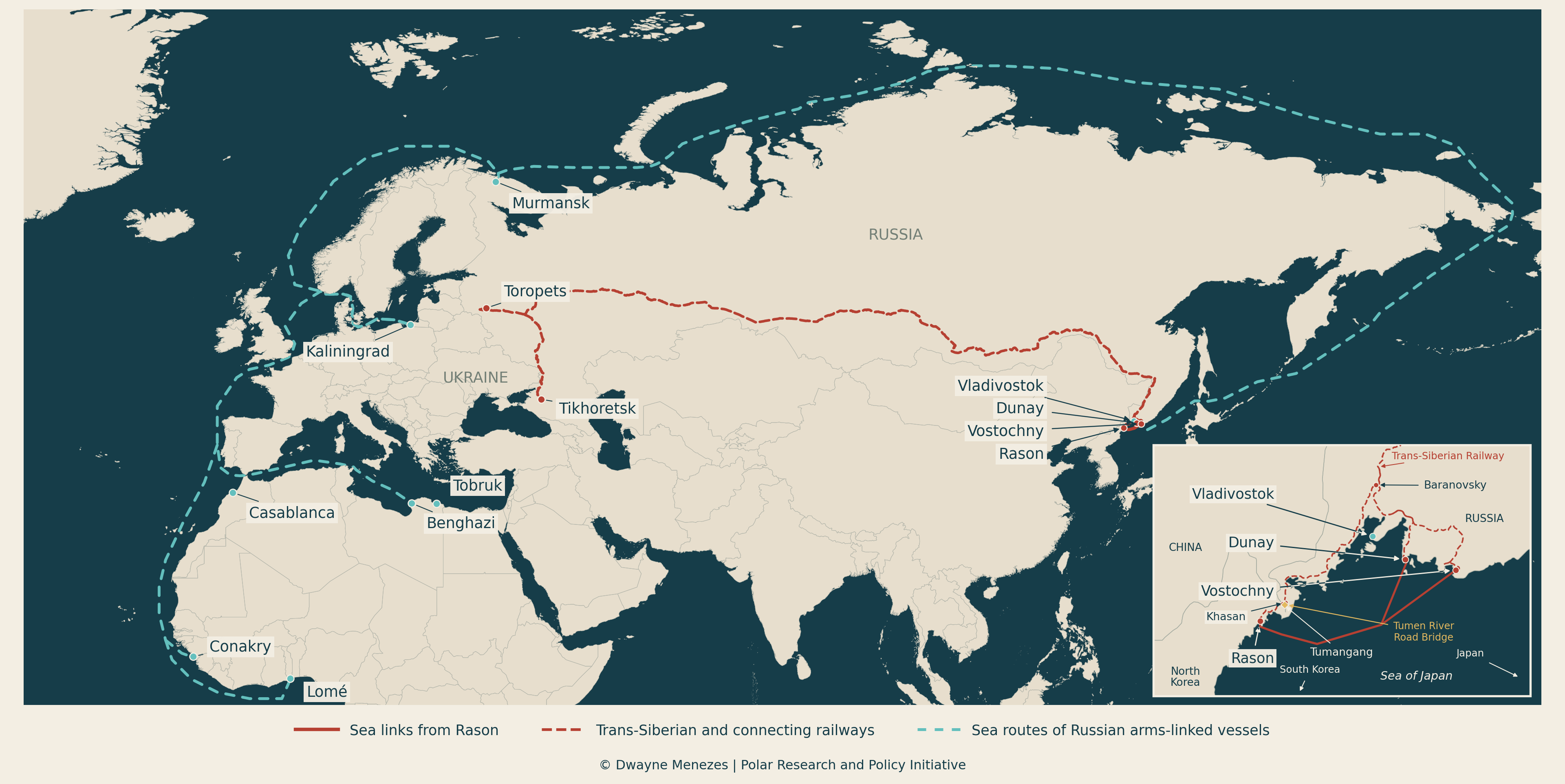
A convoy bound for Libya brings together veterans of the North Korean arms run and freighters that serve Russia’s Arctic ports. Their histories trace the trade sustaining Putin’s war and the leverage it gives Kim.
Somewhere near Sicily, the ships turned.
The ships were bound for Libya. On 22 November 2026, naval drones struck the Russian corvette Merkury (pennant 734) in Benghazi and the freighter Angara (IMO 9179842) offshore. Ukraine claimed responsibility.
A European military official who was tracking a separate Russian convoy told Reuters that it reversed course near Sicily that day. Three military and security sources told the agency the convoy was carrying military vehicles. Satellite images published by The Insider placed the ships off Algeria on 24 November, heading west.
Among the ships that turned back was Maia-1 (IMO 9358010). A month earlier, it had sailed past northern Norway. With it in the Mediterranean were Lady R (IMO 9161003) and Lady D (IMO 9349289), escorted by the Russian frigate Admiral Golovko (pennant 456).
The convoy had sailed from Kaliningrad, but the histories of two of its freighters reach much farther east. Both Maia-1 and Lady R had loaded containers at Rason, a port city in North Korea’s northeastern corner near the Russian and Chinese borders. Angara, the freighter hit off Benghazi, had helped open the supply route from there for Russia’s war in Ukraine.
The trail back to Rason
Rason’s position once encouraged hopes of a commercial gateway between three countries. Since 2023, containers leaving its quays have served a more urgent Russian demand. They have crossed the northern gulfs of the Sea of Japan to the ports of Dunay and Vostochny in Primorsky Krai in Russia’s Far East. From there, the Trans-Siberian Railway has provided the long connection west towards the war in Ukraine – to places such as Tikhoretsk (Krasnodar Krai), Toropets (Tver Oblast), Mozdok (North Ossetia-Alania) and Yegorlykskaya Airfield (Rostov Oblast).
A short sea crossing might seem unnecessary given that Russia and North Korea share a 17-kilometre land border just north of Rason. Yet overland capacity remains limited. While the dual-gauge Tumangang-Khasan railway line – and a newly opened road bridge across the Tumen River – carry fuel, military vehicles and oversized artillery directly into Russia’s rail network, single-track bottlenecks and border transloading slow high-volume movements and expose cargo to satellite monitoring. Shipping containerised munitions by sea to Dunay and Vostochny allows Moscow to move bulk loads at scale while keeping the supply line flexible.
An April 2025 investigation by the Open Source Centre identified 64 voyages by four Russian ships, carrying an estimated 15,800 containers. Those containers could have held 4.2-5.8 million artillery shells and rockets. The ships were Maia-1, Angara, Maria (IMO 8517839) and Lady R, the first two of which are owned by MG-Flot, while the latter two, by Sovfracht. In March 2026, IStories and the Open Source Centre used port records and satellite imagery to extend the reconstruction to at least 112 voyages and 29,488 containers between September 2023 and January 2026. On their estimates of how the ammunition was packed, that volume could account for 8-11 million rounds.
The trade breaches an arms embargo that Moscow helped write – and repeatedly voted to impose. Between 2006 and 2017, Russia joined unanimous UN Security Council votes to adopt resolutions 1718 (2006), 1874 (2009) and 2270 (2016), which prohibit weapons transfers alongside military training and assistance. At the time, Moscow strongly opposed North Korea’s nuclear and ballistic missile tests near its Far Eastern border and backed strict sanctions to uphold the global non-proliferation regime – a stance it reversed only after its 2022 full-scale invasion of Ukraine created an urgent appetite for North Korean shells and missiles. Russia’s status as a permanent Council member does not exempt it from obligations it helped codify.
The UN Security Council established its Panel of Experts in 2009 to investigate breaches of North Korea sanctions. After Russia vetoed its renewal in March 2024, the Panel’s mandate expired on 30 April. Eleven governments – Australia, Canada, France, Germany, Italy, Japan, the Netherlands, New Zealand, South Korea, the United Kingdom and the United States – formed the Multilateral Sanctions Monitoring Team (MSMT) that October to continue documenting violations outside the UN framework. The UN sanctions and the Council’s 1718 Committee remained in place.
In its account of the strike of November 2026, Ukraine’s security service gave Angara the same IMO number that appears in the March 2024 report of the Panel of Experts. The panel had traced Angara and Maria on the Rason-Dunay run as early as September 2023 and recorded all four freighters in its report. Reuters checked the strike footage against visible features of the ship, and the US Treasury’s sanctions register independently ties Maia-1’s number to the freighter it lists under MG-Flot.
What Moscow and Pyongyang gain
For Moscow, the first dividend was measured in shells. North Korea could supply ammunition for Soviet-designed artillery already in Russian service, bolstering Russian stocks while domestic factories were expanding production. The Multilateral Sanctions Monitoring Team’s May 2025 report cited a participating government’s assessment that Pyongyang supplied at least 100 ballistic missiles in 2024 alone, as well as heavy artillery and multiple rocket launchers. North Korea was helping Russia sustain fire at the front and adding to the weapons Moscow could use to strike Ukrainian cities.
The troops answered a different need. After Ukrainian forces crossed into Russia’s Kursk region in August 2024, Pyongyang began deploying troops that October. By 4 November, the Pentagon estimated that 11,000-12,000 North Korean troops were in Russia, including at least 10,000 in Kursk. Both governments acknowledged the deployment in April 2025. By September 2026, Ukrainian and South Korean estimates cited by Reuters put the cumulative number sent at 14,000-15,000, with most deployed in Kursk. South Korea’s National Intelligence Service had estimated in February that roughly 6,000 had been killed or wounded. For Russia, the deployment brought fresh troops to a fight on its own territory. For Kim, Kursk became an expensive education in a kind of war his army had scarcely had to fight.
Some of what Pyongyang received could be seen at Russian oil terminals. The Open Source Centre and the BBC estimated that North Korean tankers took on more than a million barrels of oil in Russia between March and October 2024. Their analysis tracked the tankers through satellite imagery and port calls. The monitoring team cited those shipments in assessing compliance with the UN’s annual cap of 500,000 barrels of refined petroleum, imposed by Resolution 2397 (2017). It also cited a participating government’s assessment that Russia helped North Korea make payments through rouble accounts opened at a bank in South Ossetia, giving sanctioned North Korean banks a channel for settling transactions.
The military returns may last longer than any shipment of fuel. The Multilateral Sanctions Monitoring Team reported assessments from participating governments that Russia supplied short-range air defences, including at least one Pantsir-class system, and electronic warfare equipment. Russian forces trained North Korean troops in artillery, drone and infantry operations. One government also assessed that Russia shared data from North Korean ballistic missiles fired in Ukraine, helping Pyongyang improve their guidance. The exchange gives North Korean officers and engineers evidence from a live battlefield, where Ukrainian forces are continually adapting to Russian weapons.
Kim also gained a written Russian commitment. Article 4 of the Comprehensive Strategic Partnership Treaty, signed in June 2024, requires either party to provide military and other assistance without delay if an armed invasion puts the other in a state of war. Moscow’s veto of the Panel of Experts’ renewal supplied a different kind of protection: it removed the UN investigators just as the trade they were examining was expanding.
Russia is the much larger power, and much of what Kim wants still depends on decisions in Moscow. But the Kremlin now plans a war around supplies it cannot take for granted. A delay in the next consignment, or a refusal to send another contingent, is a decision Pyongyang can make for itself.
The price of an ally
That leverage becomes important when Russia pursues interests Pyongyang does not share.
On 20 October 2026, Russian Deputy Foreign Minister Andrey Rudenko said Moscow would welcome practical steps by South Korea towards normalising relations. Rudenko’s public remarks preserved an opening to Seoul. They conveyed, or at least implied, that Russia can value North Korean military support while wanting to recover diplomatic and commercial options in South Korea. From Pyongyang, however, the same opening could look more like an ally making room for an adversary.
Ukrainian intelligence’s claim on 26 November suggests that this difference has become a dispute. According to the agency, Foreign Minister Choe Son Hui objected to Moscow’s proposed role in easing inter-Korean tensions and demanded an explanation. Kim allegedly paused missile and artillery deliveries and Russian military overflights, while withholding agreement to a much larger troop deployment. Reuters could not independently verify the account, including the remarks attributed to Choe and Rudenko about mediation.
The reported military difficulties are more intimate. Ukraine’s defence intelligence, summarised by ArmyInform, describes language barriers, too few interpreters, poor coordination and inadequate logistical support, alongside heavy North Korean casualties. It also alleges contemptuous treatment by Russian commanders. This account remains unverified. If accurate, it would place friction inside the deployment itself, over how North Korean soldiers are commanded, supported and expended.
Sending ammunition creates one set of obligations; sending soldiers creates another. Kim may gain combat experience and Russian support, but he must decide how many men to commit and what treatment to accept. Moscow’s appetite for assistance does not settle those questions for him.
A temporary interruption could therefore be a means of bargaining within the partnership. Kim would have little reason to surrender its benefits merely to demonstrate that he has limits. Diplomatic contacts have continued: Putin received senior North Korean official Jo Yong Won in November. For Moscow, a lasting break would jeopardise a major source of ammunition. For Pyongyang, it would put Russian fuel, equipment and diplomatic protection at risk.
Whatever political strain exists between Moscow and Pyongyang, the European military official tracking the convoy gave Reuters a more immediate, tactical explanation for its turn off Sicily: the drone attack near Benghazi.
The northern passage
Maia-1’s northern passage was part of a longer Arctic history. In August 2025, it sailed towards Arkhangelsk and later continued along the Siberian coast to Pevek. On 29 September 2026, it passed west through the Vilkitsky Strait into the Kara Sea. The Barents Observer tracked it southbound along Norway on 22 October, after it left waters near Kildin Island outside Murmansk the previous day. Satellite imagery from 17 October showed a ship resembling it in a nearby bay.
Lady D had worked the same northern corridor. On 28 July 2024, it departed Arkhangelsk on a state-funded voyage along the Northern Sea Route towards the Far East, with calls including Pevek and a planned return to Murmansk. Construction materials and provisions were to travel east; fish products were to come back west. Thus, the freighter later seen carrying military cargo towards Libya had also served the civilian supply system linking Russia’s Arctic settlements and Pacific ports.
The Northern Fleet supplied the escort. On 2 November 2026, it announced that Admiral Golovko had departed Severomorsk, on the Kola Peninsula, for an Atlantic deployment – sailing south from the Barents Sea rather than along Siberia’s Northern Sea Route. The three freighters, meanwhile, assembled in the Baltic at Baltiysk; Lady R had surfaced near St Petersburg by late September after years on the North Korean run, though its transit west went unrecorded in public tracking.
Even so, the Mediterranean convoy brought together vessels from Russia’s Arctic supply corridor (Maia-1 and Lady D), a veteran of the Rason arms route (Lady R) and a warship out of Severomorsk (Admiral Golovko). Whatever Maia-1 carried in the high north – no public evidence shows North Korean munitions ever reached Murmansk by sea – the voyage illustrates how the same ships used to supply remote Arctic settlements can be reassigned for military deliveries far to the south.
Putin’s new Arctic strategy, signed on 26 November, calls for stronger military logistics and dual-use infrastructure. It also prioritises transport connections between the Arctic and Russia’s Far East. These voyages show why such infrastructure matters beyond the region. A port, an ice-capable freighter or a naval base may serve local supply needs on one assignment and Russia’s military reach on the next.
Off Sicily, Moscow had brought together freighters from its North Korean and Arctic runs under a Northern Fleet escort from Severomorsk, even as Ukrainian drones struck Angara – another veteran of the Rason route – off Benghazi. Tracking these movements exposes how the Kremlin stretches a small, sanctioned fleet across distant theatres, and why treating Arctic shipping as purely regional misses its role in Russia’s wider war logistics.
The reliance on North Korea also carries a cost: because Moscow’s supply lines now depend on North Korean stockpiles, Pyongyang holds real leverage over the pace of Russia’s campaign – a means of pressing its own demands. The next sighting of Maia-1 will be just another position on a chart, but its meaning will depend on how much of that history travels with it.